Growth in India will pick up from current levels, says LEO Puri, managing mirector, UTI Asset Management Company.

Pragmatism and flexibility is a virtue. An untethered and short-term approach to policymaking is a flaw, argues Mihir S Sharma.

Though COVID-19 and the subsequent lockdown left a trail of economic devastation on most countries, India can potentially build upon three positive aspects - push in the rural economy, stronger federalism and a huge consumption base, former RBI Governor Duvvuri Subbarao Rao has said. In his foreword on a Telugu book titled "Maandhyam Mungita Desam" (Nation in Recession) authored by Tummala Kishore, he said the challenge for the government in the months and years ahead is clear: to put the economy back on a healthy growth trajectory and ensure that growth is inclusive, with lower income households too enjoying the benefits of rapid growth.

A British brokerage on Tuesday cut India's FY22 GDP growth estimate by a sharp 0.80 per cent to 9.2 per cent, saying the economic impact of the second wave of infections has been deeper than initially expected. Barclays chief India economist Rahul Bajoria also mentioned the slow pace of vaccinations in the country and the rolling lockdowns across many states for the estimate. It can be noted that last month has seen a slew of similar forecasts from analysts, even as the RBI maintained its estimate of a 10.5 per cent growth in real GDP.

Microsoft India on Tuesday said it has collaborated with Invest India to support tech startups in the country. As part of the partnership, the Microsoft for Startups programme will work closely with Accelerating Growth of New India's Innovations (AGNIi Mission) - a programme of the Office of the Principal Scientific Adviser to the Government of India, a statement said. Housed and executed by Invest India, AGNIi Mission helps startups become enterprise-ready.
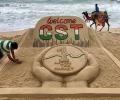
GST collections touched a record of Rs 1.40 lakh crore in January on rapid economic recovery, Finance Minister Nirmala Sitharaman said on Tuesday. In her 2022-23 Budget speech, the minister said there has been a remarkable progress made in the Goods and Services Tax (GST) regime, but still a few challenges remain. "Gross GST collection in January at record Rs 1,40,986 crores; this has been possible due to rapid economic recovery," she said while presenting the Budget in the Lok Sabha. January is the seventh straight month when the GST collection has crossed the Rs 1 lakh crore mark.

Finance Minister Nirmala Sitharaman is scheduled to address the post-budget meeting of the RBI's central board on Monday and highlight key points of the Union Budget 2022-23, including the fiscal consolidation roadmap and high capex plan. It has been a custom that the finance minister addresses the RBI board, consisting of RBI Governor and existing four deputy governors, after the Budget. The meeting has been scheduled for February 14 where she would be addressing the board members and talk about announcements made in the Budget to perk up growth hit by three waves of COVID-19, sources said.

Even as India strives to climb the development mountain, the fact is that the mountaintop is already crowded. If it got there in 2047, India would be very much a late-comer, observes T N Ninan.

The real risk is that the core assumption -- that the votes for a candidate sponsored by an alliance will at least equal the sum total of its parts -- proves to be facile, observes T N Ninan.

Bolstered by improved domestic demand, India's services sector expanded for the fourth consecutive month in January as business activities quickened and rising business optimism is set to sustain the growth momentum, a monthly survey said on Wednesday. The seasonally-adjusted India Services Business Activity Index rose from 52.3 in December to 52.8 in January, pointing to a quicker expansion in output. The index was above the critical 50 mark that separates growth from contraction for the fourth month in a row during January.

Wrapping up his four-day state visit to the US, Prime Minister Narendra Modi on Friday asserted that a new and proud journey of India-US ties has begun and the world is watching the two great democracies strengthening their bond.
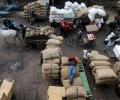
India's economy grew by 1.6 per cent in the fourth quarter of 2020-21, restricting the full-year contraction to 7.3 per cent, official data showed on Monday. The fourth quarter growth was better than the 0.5 per cent expansion in the previous October-December quarter of 2020-21. The gross domestic product (GDP) had expanded by 3 per cent in the corresponding January-March period of 2019-20, according to data released by the National Statistical Office (NSO).
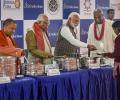
Modi stressed his government has created a 'security cover' to ensure good heath of children and mothers during the past 55 month of his rule.

'ISRO's style is a terrific example of being able to survive, acknowledge failures, and then most importantly of all, learn from them to ensure that subsequent missions are successful.'

Get more people working, get more people working in modern manufacturing and services in our cities, and get people working better and longer, suggests Naushad Forbes, past president, CII.

With Nirmala Sitharaman's Budget presentation lasting for about one hour 31 minutes on Tuesday, the finance minister's budget speech this year became the shortest ever since 2019.

For one thing, US Fed Chairman Ben Bernanke was perhaps right in postponing the quantitative easing taper even though the markets had complained at that time that they were primed for some reduction in QE3 and the Fed had missed an opportunity to execute their plans without causing too much of a flutter.
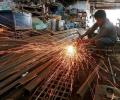
India's manufacturing sector activities eased slightly in February but firms were upbeat as they responded to increased new work intakes by stepping up production and purchasing activities, a monthly survey said on Monday. The seasonally-adjusted IHS Markit India Manufacturing Purchasing Managers' Index (PMI) fell marginally to 57.5 in February from 57.7 in January, indicating that even though the pace of growth eased from January it remained sharp in the context of historical data. The headline figure for February remained above its long-run average of 53.6, the survey noted. In PMI parlance, a print above 50 means expansion while a score below 50 denotes contraction.

'Increased allocations for MNREGA could have provided the much needed push to rural demand and consumption at a time when recovery continues to remain uneven.'

Much on the expected lines, Beijing reacted angrily to Hands' visit, saying that it violates the one-China principle to which London is a signatory.

'The fiscal pressure will be there, but the intent of the government behind this move is to spur demand and growth.'

The sweeping economic sanctions on Russia - the second largest producer of crude oil - following its invasion of Ukraine late last month can cull global and domestic growth along with the added pains of higher inflation and currency depreciation, RBI Deputy Governor Michael Patra has said. And if the war lingers on, it can even lead to deglobalisation and even a recession, he added. The ongoing war has only added a whole new dimension to the outlook, and in fact, a weighty downside, Patra said in a lecture at the industry lobby IMC on Friday evening.

India's new policy commission has received a makeover and a dream team has been formed to head the Think Tank, NITI Aayog.

The Modi government's array of economic policy has been impressive.

Bringing in the untapped informal sector into the formal one will benefit business.
The finance ministry and RBI must get less conservative and improve co-ordination.

Foreign Direct Investment flows to India in 2021 were 26 per cent lower, mainly because large M&A deals recorded in 2020 were not repeated, the UN trade body has said.
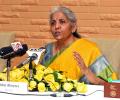
Macroeconomic management is usually a lot more comfortable with lower fiscal deficits. The sooner we get there, the better for the economy, says former Chief Economic Adviser to the Government of India Shankar Acharya.
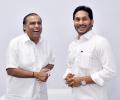
'We would like to develop Andhra Pradesh into a logistics hub not only for India, but also for South Asia.'

As hard bargains continue for the next four days at the picturesque tourist resort of Indonesia, the ministers., including from the influential developed countries will try and reach agreements on providing windows to the developing nations for their food security programmes and a pact to free the global trade from the procedural hassles at the customs.

The World War I had been triggered by an assassination in then relatively unknown Serbia.

The NSE Nifty, comprising 50 shares, breached the 8,300-mark for the first time to hit a new lifetime high of 8,330.75.

Markets are assuming that by the second half of 2021, the world will be approaching some type of normalcy, points out Akash Prakash.
In August, domestic equity markets garnered one of the highest foreign portfolio investor (FPI) flows since the outbreak of the pandemic in 2020, despite the US Federal Reserve standing firm on unwinding its stimulus measures to control inflation. FPIs pumped in over Rs 51,000 crore ($6.4 billion) in August, the most since December 2020 and the third-highest tally since March 2020-the month the Covid-19 pandemic roiled global markets. This was the second consecutive month of positive foreign flows. In the preceding nine months, FPIs had yanked out over $32 billion or Rs 2.2 trillion.

In the face of testing global conditions, the Ministry of Textiles has stayed the course by introducing timely policy changes and innovative programmes aimed at spurring growth and development across the organised and unorganised sectors of the industry.

The World Bank has approved loans totalling $1.75 billion (about Rs 13,834.54 crore) to fund India's PM Ayushman Bharat scheme and private investment to boost the economic growth. Of the total loan, $1 billion will go towards the health sector, while the rest $750 million will be in the form of development policy loan (DPL) to fill the financing gaps through private sector investment in the economy. The World Bank Board of Executive Directors approved two complementary loans of $500 million each to support and enhance India's health sector.

EAM Jaishankar's mission is aimed at strengthening India's strategic autonomy in a complex international environment, observes Ambassador M K Bhadrakumar.

Theoretically, the currency with the public should expand in sync with the nominal income, which again moves in relation to the nominal growth rate of the economy. But the correlation breaks easily when other factors come into play, says Anup Roy.

With a 50 per cent increase in the last four years, Madhya Pradesh has the maximum number (785) of tigers in the country, followed by Karnataka (563), Uttarakhand (560), and Maharashtra (444), according to the data.
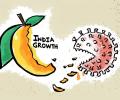
'In the real economy, the scars of the pandemic will continue to define 2021.' 'It is still hard to tell the effect on unemployment, migrant workers, poverty, and the informal sector of the lockdown and of the pandemic,' observes Mihir S Sharma.
